BaZi is a Chinese system that converts your birth date and time into four pillars, one each for the year, month, day and hour, with two Chinese characters in every pillar. Eight characters in total. They describe your natural strengths, your blind spots, and the timing of the decades ahead. What the chart does not describe is your outcome. That part is yours.
Your horoscope tells you you are a Scorpio. That label covers roughly 650 million people. BaZi builds a chart from four data points unique to your moment of birth, which is why it gets used for decisions about when to launch, when to hold, and what kind of work suits you, rather than for personality labels.
BaZi (八字) means “eight characters.” Your birth year, month, day and hour each produce two Chinese characters, a Heavenly Stem and an Earthly Branch. Four pillars, two characters each, eight characters total. This is why BaZi is also called the Four Pillars of Destiny.
Those characters are best understood as codes, closer to DNA than to labels. They represent your energy, or your vibrational makeup. Your chart is an energy imprint formed by the configuration of the energy planes at the time of your birth.
This matters more than it sounds, because it changes what the five elements are. Most beginners meet Wood, Fire, Earth, Metal and Water as physical forms, and often as colours. As you go further into the study, you come to read them as vibrational energies rather than as objects. The Chinese term 五行 uses the character 行, which means movement or phase. Five moving energies, not five substances.
No. There are two major systems, and they run on different calendars.
| BaZi | Purple Star Astrology (Zi Wei) | |
|---|---|---|
| Calendar | Chinese solar calendar | Chinese lunar calendar |
| Learning it | Easier to learn, but more abstract | Harder to learn, many stars |
| Applying it | Needs a strong foundation in the five elements and real life experience | Often easier to read an outcome from |
Both are accurate. Accuracy in either depends far more on the experience of the person using it than on the system itself, which is equally true of Western and Vedic astrology.
One practical consequence: for BaZi you use your Western date of birth, and the software converts it to the Chinese solar calendar. Your lunar birthday is only used for Purple Star.
A chart has three layers of characters, not two.
| Component | Position | What it represents |
|---|---|---|
| Heavenly Stems | On top of each pillar | Surface level energy. Your appearance, and what you display to the external world. |
| Earthly Branches | Below the stems | The animal signs. They carry time. |
| Hidden Stems | Inside the branches | What sits deep in your subconscious. Personality and talents you may not know you have. |
The clearest way to picture the relationship: the Earthly Branch is a house, and the Hidden Stems are its occupants.
Hidden Stems are not permanently hidden. When one appears in a Luck Pillar, it surfaces. Something that was submerged becomes visible to the outside world, or simply becomes available to you. This is why people develop capabilities in their forties that nobody around them predicted at twenty.
From the four pillars of the Natal Chart come two further layers: the 10 Years Luck Cycle, and the Annual Luck Pillar for the current year.
Traditionally the four pillars were read as family members. The year was your grandparents, the month your parents, the day yourself and your spouse, the hour your children. That reading came from an era when a consultation was largely about lineage.
The Joey Yap system reads them for a modern context instead, and this is a departure you will not find in traditional BaZi books. The year is treated as your external world, meaning your market, your industry and your network, because the year pillar is your first point of contact and people know you from the outside in. The month is treated as the Career Palace, governing what you do for a living. Some practitioners place career on the hour pillar. In this system that is not correct.
The month carries the most weight of the four, for two reasons. It sets the seasonal context that determines how strong every element in the chart is, and roughly seventy percent of the quality of a person’s life is described by what they do. The second question anyone asks after your name is what you do.
The day pillar deserves one note, because it holds relationships. That surprises people who assume relationship quality is an external matter of meeting the right person. It begins with you. You cannot find someone to love you if you are not lovable in the first place.
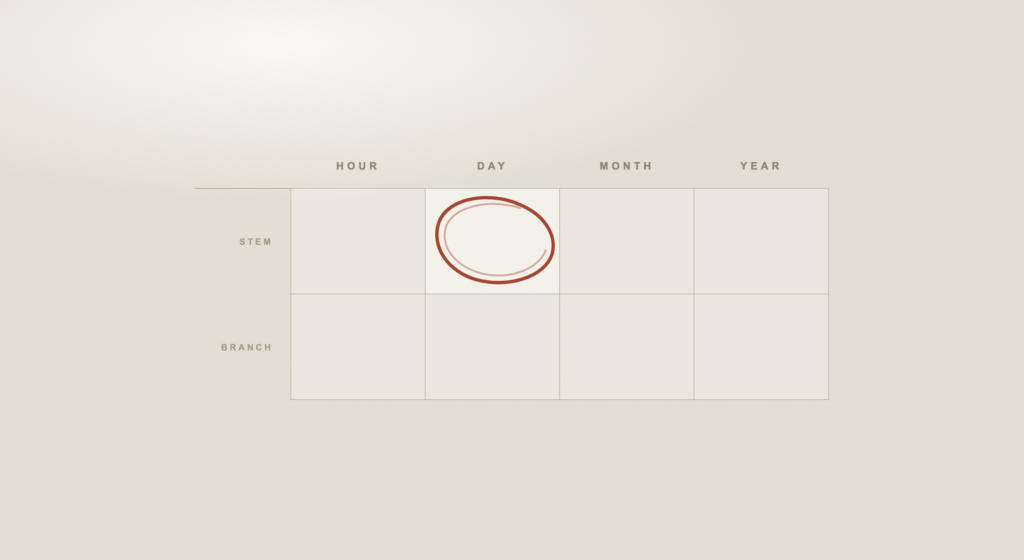
Your Day Master is the Heavenly Stem of your Day Pillar, the top character of the third column. It represents you, and every other character in the chart is read by its relationship to it.
There are ten possible Day Masters, being the five elements in yang and yin form.
| Element | Yang | Yin | Broad character |
|---|---|---|---|
| Wood | Jia 甲 | Yi 乙 | Growth and expansion |
| Fire | Bing 丙 | Ding 丁 | Passion and visibility |
| Earth | Wu 戊 | Ji 己 | Safety and stability |
| Metal | Geng 庚 | Xin 辛 | Differentiation and analysis |
| Water | Ren 壬 | Gui 癸 | Flexibility and intelligence |
Yang and yin here are not good and bad, or positive and negative. They are simply polarities, like left and right, or seen and unseen, or external and internal.
To find yours, plot your chart with a BaZi calculator and read the top character of the Day column.
No, and this is the most common misreading in the whole subject.
Strength here has nothing to do with being personally strong. It describes how much support the chart gives your element. Some energy is louder, some is softer. What strength tells you is what the chart needs more of, not how well your life will go.
Consider someone born in a Water month, in the depth of winter energy. That chart is cold, and what it needs most is Fire. Is Fire strong in a Water month? No, because Water puts Fire out. But it is not a bad element. It is a good element, precisely because it is needed. A person whose chart runs on a necessary element is often the one who is always wanted, always relied on, always taken care of, because they matter inside the structure of that chart.
Weak does not mean bad. A weak but necessary element can be the most valuable thing in a chart.
The general rule taught in most BaZi texts is that the more balanced the five elements, the better the chart. That rule is worth arguing with.
An imbalanced chart has its own beauty. Certain parts of that person’s life will be intense and strong, while other areas will not be as good, and that is how the lives of remarkable people usually look. A chart with a perfectly even distribution across all five elements often describes a life that is not especially colourful.
Work life balance is better understood as work life integration. As Einstein put it about life in general, it is like riding a bicycle. You have to keep moving to maintain the balance.
The Ten Gods describe the relationships between your Day Master and every other character in your chart. They are the layer that turns a list of elements into a readable description of a person.
There are only five possible relationships between any two elements. One produces you, you produce another, one controls you, you control another, and one is the same as you. Each of those five has a yang and a yin version, which is where the ten come from.
The Ten Gods are also called the ten stars, and the most useful way to think about them is as ten groups of activity, skill and ability, because that is what makes them actionable rather than merely descriptive.
In this system each one also carries a name describing the kind of person it produces. These are the Ten Profiles, and they include The Analyser, The Warrior and The Pioneer among others. A chart does not give you one profile. It gives you a main profile and usually one or two sub profiles, each at a different strength, which is why two people who share a Day Master can be so unalike. Your own profiles appear in your chart when you plot it.
Luck pillars are ten year periods that layer new elements over your natal chart. Each one shifts the balance, either strengthening what was weak or overloading what was already heavy.
They are widely misunderstood as a forecast of events. They are not. A luck pillar is a different energy framework, and what it gives you is awareness of which opportunities are around you. Most of the time we fail to see a way out of a problem not because no way exists, but because we are unaware of what is available and who could help. A change in the surrounding energy is often what makes an option visible that was there all along.
Every ten year transition tends to bring a real shift in how you see the world, how you feel about your life and how you experience your career. It happens gradually, but looking back, the change is large.
Annual and monthly pillars work the same way over shorter spans, which is what an annual assessment reads.
No, and you do not need to. The distinction that matters here is between fate and destiny, and it is the foundation of this whole approach.
Most traditional astrology systems are fatalistic in doctrine. Their methods leave the impression that everything is already settled, and they encourage acceptance of it. This system does not take that view.
Fate is what you did not choose. You cannot choose the family you were born into. If you walk into a bar one evening and meet the person of your dreams, that is fate. What you choose to do after you meet them is destiny.
The chart is fate. It is fixed. What you do with it is not. And if you do nothing, you simply hand your life over to whatever tendency the chart carries, which for most charts drifts rather than flourishes.
Through actions, not objects. This is worth stating bluntly, because the opposite belief is everywhere.
The common version goes like this. My water is weak, so I will wear black and blue, and that will strengthen my water. It does not do that. What you wear does not change your elements. The same applies to pendants and ornaments sold on the promise of bringing an element into your life. That is stretching the idea of the five elements well past what it means.
Here is what does work. Each of the Ten Gods represents a group of activities. Identify which activities belong to the element you need, then perform them. That is how the element enters your life. Actions change a person’s destiny. Objects do not, and an object that does not remind you to do the right thing serves no purpose at all.
This is also the clearest difference between the two main disciplines. BaZi is action based. Feng Shui is position and direction based. Having metal objects in a room does not strengthen the metal in your BaZi.
Worth stating plainly, because the field is full of claims that do not survive contact with practice.
Start by plotting your chart with a BaZi calculator. You need your birth date, your birth time and your birth location. Find your Day Master at the top of the day column, and note which month you were born in, because that is what sets the strength of everything else.
That much you can do on your own this afternoon. Reading the chart is a different matter. Weighing one accurately means holding the elements, the Ten Gods, the seasonal strength and the current luck pillar against each other at the same time, and that takes either structured study or an experienced pair of eyes. If you want to learn to do it yourself, that is what the BaZi Academy is for. If you want your own chart read, that is a consultation.
Once you know your chart, three questions usually follow. What your Day Master is and why a weak one is not a bad one. What a BaZi reading actually covers, and what it cannot tell you. And if you are choosing a date for something that matters, how the Tong Shu is used to pick one.
Get Joey Yap’s latest insights and updates straight to your inbox.
Article, Feng Shui
Flying Star Feng Shui calculates a chart for a building from its direction and period. Here is what Period 9
Article, BaZi, Channelling Kongming
A Rob Wealth year is usually read as a threat to defend against. Read more carefully, the warning inside it
Article, BaZi
Your Day Master is the one character in a BaZi chart that represents you, out of ten possible types. Here
Article
The Tong Shu is the Chinese almanac used to select auspicious dates. It scores every day by its Day Officer,