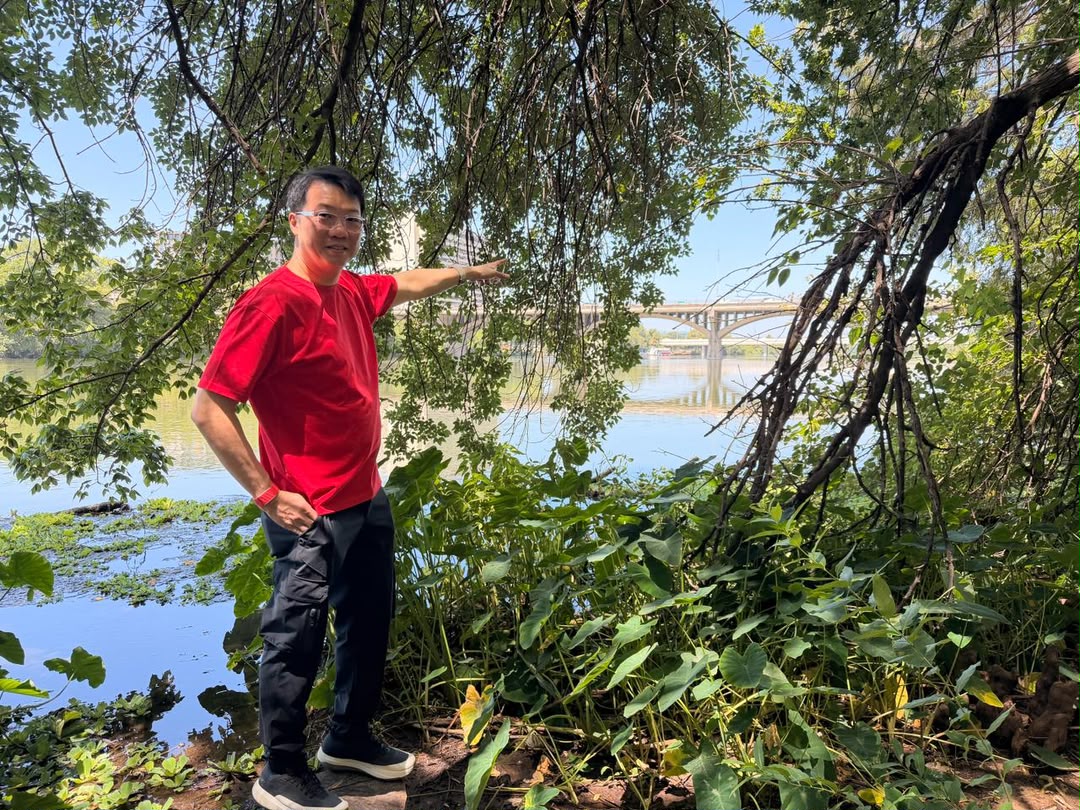
I got to Austin a few days ago. The river is a short walk from my door, and I’ve been staring at it more than a grown man probably should.
Here’s the thing about visiting a new city as a Feng Shui practitioner: eventually somebody corners you and asks, “So… is this place good Feng Shui?”
And after thirty years, I’ve learned this question is unanswerable. Not because the answer is mystical. Because the question is lazy. Good for whom? A tourist, an investor, a business owner, and a parent picking a place to raise kids are all standing on the exact same dirt, and the dirt is telling each of them something completely different.
So let’s read Austin four times. Once for each of them. And this time I’ll actually show you the method instead of just waving my hands, because Austin makes it easy. It has one big secret all four readings share.
Austin sits precisely on the line where the Texas hills end and the flat plains begin. And right at that line, the city convinced its river to stop. A dam holds the water into a long, calm lake at the foot of downtown. Hills behind. Still water in front. Open land beyond.
Hold that picture. Everyone’s about to see something different in it.
Come as a visitor and Austin performs for you. The music. The food trucks, which I have investigated with what I’ll generously call professional thoroughness. The bats pouring out from under the bridge at dusk, drawing bigger crowds than some seminars I’ve given. I’m not bitter.
But here’s what I’d tell a friend: the best thing in Austin is free, and most tourists use it without having any idea what it is.
Walk the trail around the lake early in the morning. You will feel, everyone feels, a strange calm in the middle of a booming city. That feeling is not vibes. It has a precise, two-thousand-year-old explanation. The Zangshu (葬書), the text that gave Feng Shui its name, teaches that Qi (氣) scatters when it rides the wind and stops when it meets water. Moving air disperses energy. Water halts it and holds it. That’s the founding principle of my entire profession in one sentence, and the same classic ranks the priorities just as bluntly: 得水為上 [obtaining water comes first]. Before the compass, before the calculations, before everything else, get the water right.
So when a city dams its river into a wide still pool at its own heart, it has built, in classical terms, a collecting vessel. That calm on the trail is collected Qi, held exactly the way the old text says it should be, fed by springs rising cool out of the rock nearby.
Most cities make you climb something to reach their best spot. Austin lets you stroll around it before breakfast. Take the win.
The investor asks a harder question: where does the money settle, and where’s it going next?
To answer that, I have to teach you the single most important diagram in Feng Shui. It’s called the armchair formation, and it has four parts. Solid high ground at the back: the Xuan Wu (玄武), the Black Tortoise, the shell covering your spine. Lower arms embracing left and right. Open, level, bright ground in front: the Ming Tang (明堂), the bright hall, where Qi and activity pool before the seat. And ideally, water resting between the seat and the hall.
Now lay that over Austin. Hills at the back to the west. Stilled lake in front of downtown. Open plain rolling east. The city is an armchair drawn at landscape scale, facing the sunrise.
Once you see the diagram, the wealth map stops being a mystery. The Tang dynasty master Yang Yunsong (楊筠松) gave the search instruction twelve centuries ago: 山隨水曲抱彎彎,有穴分明在此間 [where the mountains follow the water’s curve in an embracing bend, there the spot plainly lies]. Now look at the map. Tarrytown, Pemberton Heights, Rollingwood, Westlake Hills, Barton Creek: all tucked into exactly that bend, on the tortoise side, backed by high ground, looking down over the curving water. They occupy the seat. And a seat, once taken, is not given up cheaply. The east side is the bright hall, and doctrine is blunt about bright halls: they’re where new Qi arrives and gathers. Which means they fill.
And the water itself tells you something about the pace of the money. The classical water canon puts it plainly: 水緩流,財聚;水急流,財聚易散 [where water flows slowly, wealth gathers; where water rushes, wealth gathers but easily scatters]. Austin took a rushing river and slowed it to a standstill in front of its own downtown. Read that sentence again as an investor.
There’s a timing layer too. In the Xuan Kong system, time moves in twenty-year cycles, and in 2024 the world entered Period 9, a fresh cycle rewarding what aligns with its new energy. A young, fast city entering a new period with its bright hall still filling is a very specific moment.
So no, the question is never “is Austin good?” The land already answered. The real question is which part of the formation matches your appetite: the settled seat or the filling hall. Those are two different investments on two different clocks, and pretending otherwise is how people lose money with great confidence.
For you, I want to leave downtown entirely and tell you about a drive I took north, to a town called Round Rock.
The town is named after an actual rock. A round, table-shaped slab of limestone in a creek, which marked the one reliable low-water crossing for wagons and, later, for the great cattle drives heading north. The entire settlement exists because of that stone. It told travellers: cross here.
Today, that same unglamorous town hosts the headquarters of Dell. I’d bet money almost none of the engineers driving past the creek know they owe their office to a rock.
I sat with that for a while, because it’s the whole of business strategy compressed into one image. And it’s exactly what the classical art of Qi Men Dun Jia (奇門遁甲) was built to calculate. Qi Men was the strategist’s instrument, consulted by generals and merchants before committing. It plots a chart of the moment, divides the situation into nine sectors, and asks two questions at once: which position holds the advantage, and which window favours the move. Position and timing, read together, never separately.
The herds that crossed at the round rock and the herds that tried their luck elsewhere were moving the same cattle to the same market. The only difference was that someone knew where the ground would hold and when to move. That’s it. That’s the edge. Nearly every strategy question I’ve ever been asked in a consulting room is, under the modern clothing, a rancher standing at a creek deciding where to cross. And the method for answering him is over a thousand years old.
The parent’s question is the quietest one, and the most serious. A holiday lasts a week. An investment has an exit. A childhood is held in one place for twenty years, and there’s no refund window.
So let me open the toolbox one last time, because Feng Shui has two halves and most people have only ever heard of the second one. The first half is Luan Tou (巒頭), the study of forms. The land itself: hills, water, the shape and embrace of the ground around a home. The second half is Li Qi (理氣), the compass methods. Directions, sectors, calculations at the door.
Parents always ask me about the second half. Door directions, bed positions, which room for which kid. Those things are real. They have their place. But the masters were unambiguous about the order of operations: forms come first. A perfect calculation cannot rescue a home on poor ground. Strong ground forgives a great deal. The land outranks the compass. Full stop.
And there’s one more classical line I’d hand every house-hunting parent, from the Song master Cai Mutang: 水本動,欲其靜;山本靜,欲其動 [water is motion by nature, you want it still; mountains are stillness by nature, you want them alive]. That’s a description of a good home disguised as a description of landscape. You want the restless thing settled and the solid thing quietly vital. Austin, almost accidentally, built exactly that: living hills behind, and a naturally restless river persuaded into stillness out front.
Which is why the first Feng Shui decision a family makes is not the front door. It’s the district. The same armchair that shelters the city’s wealth is, at its origin, a diagram of shelter itself. Tortoise at your back: protected from what arrives unseen. Still water before you: life gathering instead of rushing past.
Families here have chosen by this instinct for a century, settling into the wooded streets on the hill side of town, near the springs where their kids swim in the same cool water every season of the year.
Choose the ground first. The compass work can follow, and it’ll finally have something worth refining.
Four people, one city. Notice what happened. The tourist met the founding principle: water stopping Qi. The investor met the armchair, the bright hall, and the pace of slow water. The business owner met position and timing read as one chart. The parent met the oldest rule of all: forms before formulas.
Four pieces of one method. And none of the readings contradicted the others. That’s what a well-formed city does: it answers every question put to it, honestly, from the same ground.