Many planners report spending hours debating venue and catering, then just five minutes picking the date. That imbalance can reduce attendance and increase friction in ways that no amount of follow-up marketing fully recovers. Knowing how to choose a date selection tool for event planning isn’t just about finding a scheduling poll; it’s about understanding what each tool actually optimizes for. Some tools optimize for logistics. Others, like the systems taught by Chinese metaphysics authority Joey Yap, optimize for timing alignment, layering energy cycles and auspicious windows onto the calendar before a single invite goes out. This guide covers both worlds, gives you a practical 6-step evaluation checklist, and helps you shortlist the right tools for your specific event needs.
The market for scheduling and availability tools has grown significantly, and the feature differences between them matter more than most planners realize. A tool that works well for a team standup creates real friction when you’re coordinating a 500-person gala or a high-stakes product launch. Getting this decision right means fewer no-shows, cleaner coordination, and dates that actually serve the purpose of the event.
Two approaches to date selection: logistics-first scheduling tools versus timing-intelligence systems rooted in Chinese metaphysics.
Most planners treat date selection as a logistics problem: find a window where the venue is available, avoid major holidays, and send the invite. But the date itself carries weight beyond availability. Attendance drops when dates overlap with school breaks, fiscal quarter-ends, or low-energy periods in the cultural calendar. A poorly chosen date may substantially reduce turnout regardless of how strong the event itself is.
The planning decision happens upstream of everything else, which means the tool you use to make it shapes every outcome downstream. A date that’s convenient on paper but lands during a competitor’s flagship event, a major sports final, or a culturally significant week for your audience isn’t a neutral choice. It’s a missed opportunity that no amount of follow-up marketing can fully recover.
Conventional scheduling tools are designed to surface consensus. They answer the question: “When can everyone make it?” That’s necessary, but it’s not sufficient for high-stakes events. They don’t ask whether the date carries favorable conditions for the type of event you’re running. That gap is where meaningful planning value gets left on the table, in turnout, in press timing, in the energy attendees bring to the room.
Effective date selection operates on two layers: logistics and timing intelligence. Most tools only address the first.
Timing-intelligence tools work from a different premise. Systems like the Chinese almanac, formalized in what is known as the Tong Shu, evaluate dates based on energy classification, elemental cycles, and compatibility with the type of activity being planned. Rather than asking “when is everyone free,” they ask “which dates carry the strongest conditions for this specific purpose?” This is a structured analytical framework with centuries of documented application behind it. For high-stakes events (product launches, annual galas, fundraisers, corporate milestones), this layer of consideration adds a dimension that no attendee availability tool can provide on its own.
A standard scheduling poll collects availability. The Tong Shu Power Planner evaluates the energetic quality of each date, a fundamentally different input.
The Tong Shu, sometimes called the Chinese Farmer’s Almanac, classifies each calendar day according to a structured system of energy cycles drawn from the Five Elements, the 28 Lunar Mansions, and classical Chinese metaphysics. Each day is rated for compatibility with specific activities: wealth generation, signing contracts, hosting celebrations, launching projects, and more. This is a codified classification system that assigns a specific quality signature to every day on the calendar, not a set of vague spiritual impressions.
The practical logic is activity-specific: a date that’s auspicious for a contract signing may not carry the same quality for a large public celebration. Event planners who work with high-profile clients and culturally significant events, often attendees at events like THE BIGGIE: FSAmania Is Your Friendly Essential Guide To Joey Yap’s Feng Shui & Astrology 2026, already factor this in, often without a structured tool to support it. Having a systematic way to surface that information changes the quality of the decision.
The practical logic is activity-specific: a date that’s auspicious for a contract signing may not carry the same quality for a large public celebration. Event planners who work with high-profile clients and culturally significant events already factor this in, often without a structured tool to support it. Having a systematic way to surface that information changes the quality of the decision.
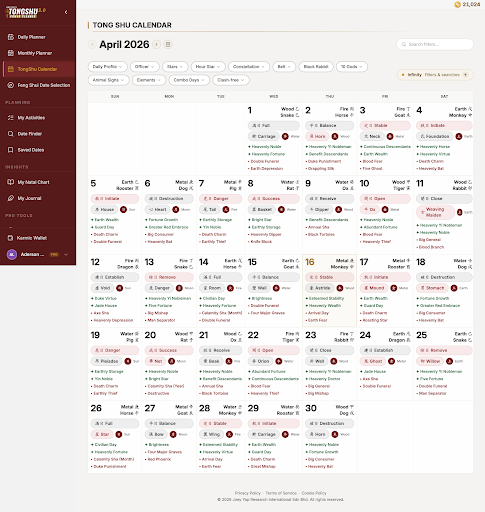
Joey Yap’s Tong Shu Power Planner (available at powerplanner.joeyyap.app) translates the traditional almanac system into a practical digital planning tool. Rather than requiring users to manually cross-reference almanac data, it surfaces auspicious dates filtered by event type and activity category. For an event planner organizing a company gala, product launch, or signing ceremony, the Planner identifies which dates in a given month carry the strongest favorable conditions and which to avoid. Used alongside a conventional scheduling poll or meeting scheduler for events, it gives planners a dual-filter approach: first narrow by availability, then refine by timing quality. Most standard RSVP scheduling tools and date pickers for events don’t evaluate auspicious timing at all, which is precisely where this tool fills a gap nothing else addresses.
The Tong Shu Power Planner filters calendar dates by activity type, surfacing auspicious windows that logistics tools don’t measure.
This checklist applies whether you’re coordinating a board retreat for 20 or a public conference for 2,000. The steps are sequential, each one narrows your shortlist before you move to the next evaluation layer. Planners who skip steps early tend to discover the gap mid-campaign, when switching costs are highest.
Step 1, Classify your event. Is it a one-time gathering, a recurring series, or a high-stakes milestone event like a launch, gala, or signing ceremony? One-time casual events need a lightweight scheduling poll or availability poll. High-stakes events warrant a dual-layer approach that includes timing intelligence alongside standard availability collection.
Step 2, Map your attendee profile. Are attendees internal (same organization, same timezone) or external (clients, global audience, mixed platforms)? External audiences require strong timezone handling and no-account voting so participation barriers stay low. If your attendees span enterprise email environments, confirm Outlook/Exchange support before committing to any tool.
Step 3, Decide if timing quality matters. For milestone events, evaluate dates not just by availability but by their energy classification. This is where pulling up the Tong Shu Power Planner alongside your availability data produces a shortlist that’s both logistically viable and strategically timed. The two approaches complement each other rather than compete.
Step 4, Run an integration audit. Confirm the tool connects to your primary calendar (Google or Outlook), your event management platform, and any CRM your team uses. Broken integrations create double-booking risk, and discovering a gap mid-campaign is a far more expensive problem than verifying support before you sign up.
Step 5, Ask the security questions. Request documentation on data encryption, GDPR and CPRA compliance, data retention periods, and breach notification protocols before handing attendee data to any platform. These questions separate tools built for professional use from tools built for casual scheduling.
Step 6, Run a live test with real users. Create a test poll with a small group and evaluate the respondent experience end-to-end, from invitation to calendar confirmation. A tool that’s frictionless for organizers but confusing for attendees is the wrong tool, regardless of its feature list.
The 6-step date selection tool evaluation checklist, from event classification through live user testing.
No single scheduling tool fits every event equally well. Conventional scheduling polls and meeting schedulers for events handle the logistics layer effectively when the priority is collecting availability and reducing friction. But for high-stakes events where the date itself carries strategic weight, layering in timing intelligence through tools like Joey Yap’s Tong Shu Power Planner gives planners a meaningful edge that pure availability data can’t provide.
Use the 6-step checklist in this guide to work through how to choose a date selection tool for event planning systematically: start with your event type and audience profile, audit integrations and security, and don’t overlook the timing quality of the date itself. The logistics and timing layers aren’t competing priorities; they’re complementary filters that together produce a date that works operationally and strategically. For practical perspectives on aligning timing with strategic shifts, see Joey Yap’s event When Opportunities Come Disguised As Disruption.
If you want to go deeper on timing intelligence for your events, the Tong Shu Power Planner is the most direct starting point. Built on classical frameworks and designed for modern planners, it brings structured timing intelligence into your workflow in a way no conventional date picker for events can match. The best date selection tool isn’t just the one that’s easiest to use. It’s the one that helps you pick a date that works on every level. Joey Yap also runs Fantastic Free Workshops for you to THRIVE in 2026 that can help planners apply these principles in practical sessions.