If you searched for a “Chinese birth chart” expecting a quick gender prediction, you’re not alone. Millions of people type that phrase every year, looking for the two-variable table that supposedly predicts whether a baby will be a boy or a girl. What they find, if they dig a little deeper, is something far more sophisticated: a structured metaphysical system that maps an entire life path from the precise coordinates of a person’s birth. These are two completely different tools, and confusing them means missing out on what the real system can actually do for you.
The classical Chinese birth chart is a BaZi natal chart, also called the Four Pillars of Destiny. It is built from four time units tied to your birth year, month, day, and hour, producing a structured picture of your elemental makeup, dominant tendencies, career alignment, relationship patterns, and a decade-by-decade timeline of shifting energies. Joey Yap, a leading Chinese metaphysics educator with over 60,000 students globally, describes BaZi not as fortune-telling but as a personal operating manual encoded at the moment of birth. That framing is worth holding onto as you read.
This article covers both tools honestly. You’ll learn how the Four Pillars chart is built and what each pillar reveals, how the Chinese baby gender predictor actually works and where it came from, how to calculate Chinese lunar age correctly, and what the published science says about prediction accuracy. By the end, you’ll know exactly which tool fits your question and what to do next.
Most people assume the Chinese birth chart is interchangeable with the gender prediction table or the twelve-animal zodiac wheel. Neither assumption holds. The zodiac assigns one animal based on birth year alone, that’s the Chinese zodiac chart, and it’s a single-variable snapshot. The actual Chinese birth chart in its classical form is a BaZi natal chart: a structured map of a person’s energetic constitution derived from four distinct time units at birth.
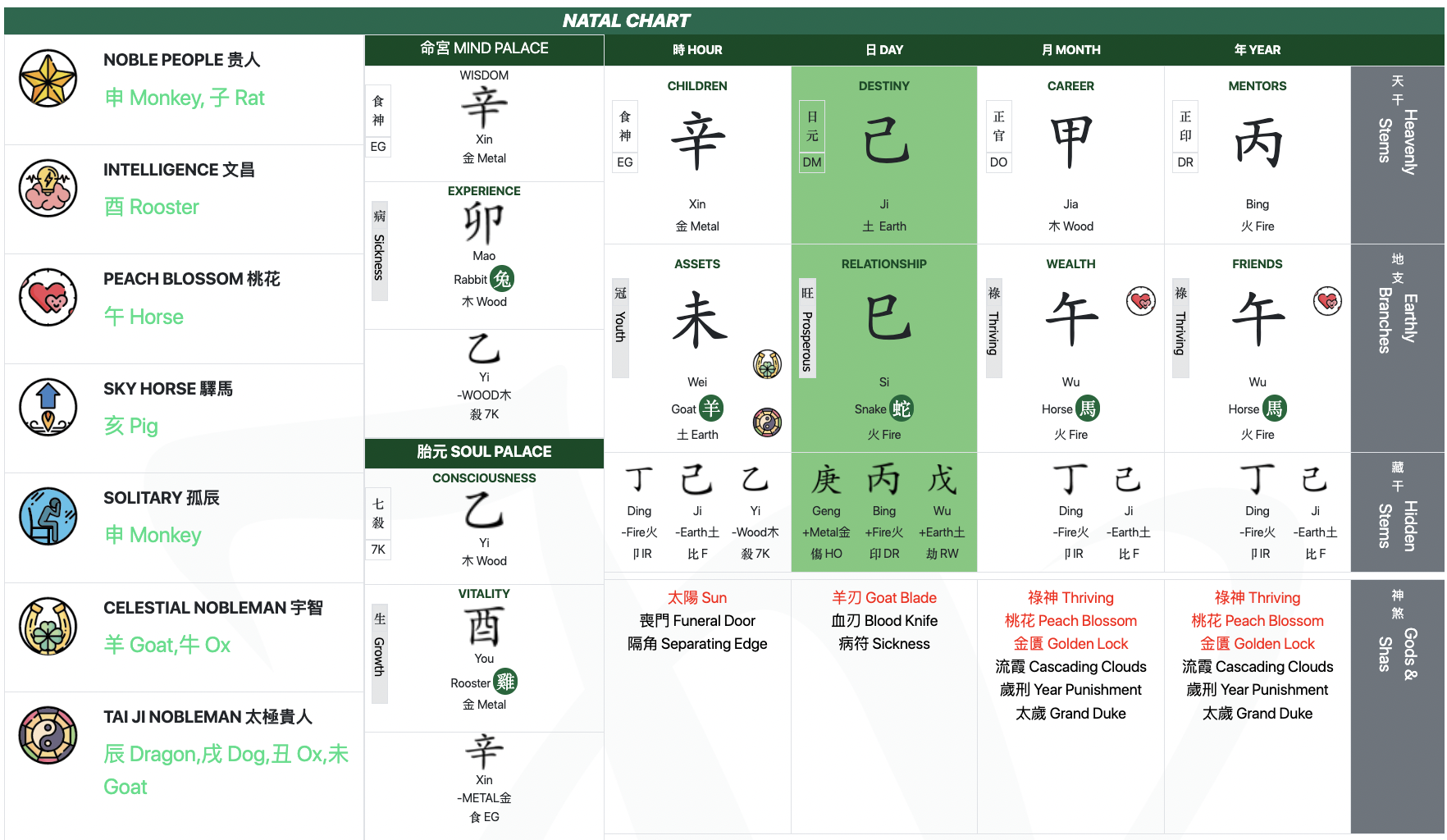
BaZi is rooted in Yin-Yang theory, the Five Elements framework (Wu Xing), and the sixty-year cycle of Heavenly Stems and Earthly Branches. Each of the four pillars in the chart contains two characters: one Heavenly Stem and one Earthly Branch. Eight characters total form the natal chart. The system is calculable, repeatable, and teachable. Anyone claiming it’s purely mystical hasn’t looked at the underlying mechanics.
The Chinese name for this system is “Si Zhu Ming Li,” which translates roughly to the Four Pillars of Life Fate. “Destiny” in this context doesn’t mean a fixed, unalterable script. It refers to a set of default tendencies, timing cycles, and potential pathways encoded at the moment of birth. Knowing your pillars gives you a strategic read on your natural strengths, the timing of your most active luck cycles, and the domains of life where friction tends to concentrate.
A BaZi chart doesn’t tell you what will happen. It tells you what you’re working with and when different types of energy are active. Consider it a planning tool, not a prophecy, and that distinction shapes everything about how you use it. A practitioner working with someone facing a career decision, for instance, isn’t predicting an outcome; they’re identifying which timing windows in the Luck Pillar timeline create favorable conditions for action. For a deeper discussion on BaZi as a decision framework rather than divination, see The Power of Decisions: Why BaZi Is Not Fortune-Telling.
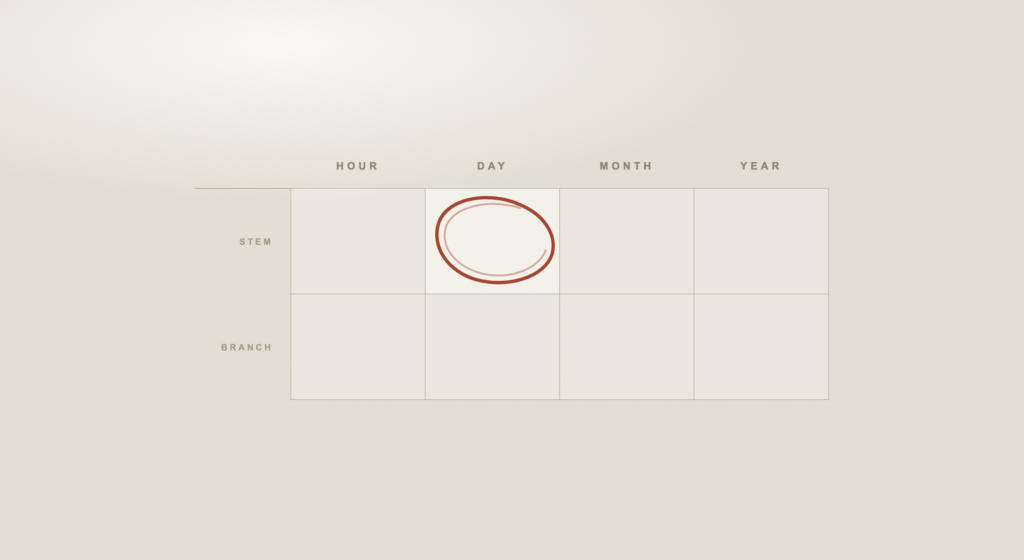
Building a BaZi chart requires four inputs: birth year, birth month, birth day, and birth hour. Each input generates one pillar, and each pillar contains a Heavenly Stem and an Earthly Branch. What most people don’t realize is that BaZi uses the Chinese solar calendar, known as the Hsia calendar, not the lunar calendar associated with Chinese New Year celebrations.
Each pillar follows its own cycle. The year pillar follows the solar year beginning around February 4th (the Start of Spring, or Li Chun). The month pillar shifts every thirty days along solar terms. The day pillar changes at midnight, and the hour pillar divides each day into twelve two-hour segments. This Chinese birth calendar logic is fundamentally different from the lunar calendar most people associate with Chinese New Year.
This is a critical distinction for anyone trying to calculate their own chart. If you were born in January before Li Chun, your year pillar belongs to the previous year in the BaZi system, even though the Gregorian calendar has already turned. Getting that boundary wrong produces an incorrect year pillar and throws off the entire reading.
The hour pillar is the most granular and personal variable in the chart. Two people born on the same day, in the same city, but two hours apart can have meaningfully different charts because the Hour Stem changes with each two-hour block. This is why a complete BaZi reading requires birth time, not just birth date. Without the hour, the chart is readable but incomplete, information about a person’s inner world, hidden talents, and later-life quality is simply missing from the picture.
If you don’t know your exact birth hour, a partial reading is still valuable. Many practitioners work with an approximate time range and narrow down the likely hour pillar based on the person’s known character and life events. It’s not ideal, but it’s not a dead end either.
Reading a Chinese birth chart follows a consistent sequence. You start with the Day Master, the Heavenly Stem of the day pillar, because every other character in the chart is interpreted in relation to it. From there you assess Day Master strength by counting how many surrounding elements support versus control it. Then you read the year and month pillars for context and career insight, and finally the hour pillar for inner world and long-term trajectory.
To illustrate: a Day Master of Yang Wood (Jia) born in a Water-heavy chart is well-supported, Water nourishes Wood, suggesting someone with strong intellectual capacity and growth orientation. If that same chart has little or no Metal, the controlling force on Wood is weak, which often maps onto difficulty with structure, deadlines, or saying no. The Luck Pillars then show which ten-year windows activate favorable elements and which introduce friction. A Metal-dominant Luck Pillar arriving in the mid-thirties for this person might mark a period requiring more discipline and boundary-setting than earlier phases demanded.
That’s a simplified example, but it illustrates the logic: the Chinese birth chart produces a coherent narrative from sequential analysis, not a list of isolated traits.
Each of the four pillars maps to a distinct dimension of a person’s life. Together they create a layered picture far more granular than a zodiac sign or a personality type label. Reading the pillars in sequence builds a coherent story from macro environment to inner world.
The year pillar represents the macro environment a person was born into: the broader energetic era, ancestral background, and the impression the outside world forms of you over time. Think of it as the stage you were born onto. The month pillar sits directly beside the day master and carries information about upbringing, the career sector where a person naturally thrives, and the work environment that supports rather than drains them. For anyone doing career planning with a BaZi chart, the month pillar is often the first place a trained practitioner looks.
These two pillars answer the question of context: where you come from and what kind of outer world aligns naturally with your chart. They don’t determine your ceiling, but they do reveal the starting conditions and the professional environments where your energy compounds rather than leaks.
The day pillar contains the most important character in the entire chart: the Day Master. It represents the self, and every other character in the chart is interpreted in relation to it. Identifying the Day Master and assessing its strength relative to the surrounding elements is the first step in any serious BaZi reading.
The hour pillar reveals a person’s inner world: their aspirations, hidden talents, and the energetic tone of their later years. Many people find that the day and hour pillars describe them more accurately than their sun sign, rising sign, or Myers-Briggs type. The specificity is simply higher because the system uses four distinct time variables rather than one.
Every character across all four pillars belongs to one of the five elements: Wood, Fire, Earth, Metal, or Water. The balance or imbalance of these elements across the eight characters tells a trained reader where energy moves freely and where friction tends to build. This is not symbolic poetry, it maps directly onto behavioral tendencies, decision-making patterns, and the types of environments where a person either thrives or struggles.
The five elements interact through productive and controlling cycles. Wood feeds Fire. Fire produces Earth. Earth holds Metal. Metal carries Water. Water nourishes Wood. The controlling cycle runs perpendicular: Wood controls Earth, Earth controls Water, Water controls Fire, Fire controls Metal, Metal controls Wood. A chart heavy in Water and Wood often indicates strong creative and strategic thinking, though the person may find structure or firm boundaries harder to maintain without conscious effort. A chart dominated by Fire typically shows natural charisma and leadership capacity, paired with real vulnerability to burnout when energy isn’t channeled well.
The elemental profile isn’t a fixed verdict, it’s a map of where leverage exists. Knowing your dominant elements tells you which environments and roles will amplify your natural strengths and which will consistently drain you.
When an element is absent or overwhelmed in a chart, it doesn’t mean that quality is simply missing from the person’s life. It means they may need to develop it consciously or seek environments and partnerships that supply it. Someone with no Metal in their chart may find decisiveness and structured follow-through harder to access naturally. That same person often benefits from partnering with people who carry strong Metal energy or building systems that provide external structure where their chart doesn’t generate it internally.
This is one of the reasons BaZi is useful for team building and partnership decisions. Knowing which elements you carry in abundance and which are absent lets you make deliberate choices about the people and environments you surround yourself with, an insight no two-variable gender chart can offer.
Rather than working through the conversion manually, most people use an online Chinese lunar age calculator. A reliable calculator needs the mother’s Gregorian birth date, the conception date or estimated conception date, and the current date to handle the New Year adjustment correctly. Different calculators may return slightly different results depending on how they handle the Chinese New Year cutoff, so cross-checking two sources before relying on the output is a reasonable precaution.
Once you have the correct lunar age and the lunar month of conception, you locate the intersection on the chart grid. The prediction is instant, which is part of why the tool spread so widely online. Simple inputs, instant output, and a 50/50 baseline chance of being correct means it feels accurate often enough to sustain its popularity.
A properly conducted BaZi reading produces a structured picture of your elemental makeup, your Day Master and its strength, the career sectors most aligned with your chart, relationship dynamics, wealth potential, and a decade-by-decade Luck Pillar timeline showing when different types of energy are active in your life. The Luck Pillars, those ten-year cycles that overlay the natal chart and shift the energetic backdrop of each major life phase, offer a level of timing intelligence that no two-variable gender chart can approach.
For someone navigating a career transition, a business launch, or a relationship decision, the Four Pillars chart provides structured input based on their actual birth data. That’s a fundamentally different level of usefulness than a lookup table.

For readers who want to learn to read their own Chinese birth chart rather than simply receive a one-time consultation, Joey Yap’s BaZi Academy offers a structured, self-paced curriculum that takes students from the foundational logic of the Heavenly Stems and Earthly Branches all the way through advanced chart interpretation. The Academy is designed for curious beginners who want to become confident chart readers, with frameworks that apply directly to career planning, business timing, and personal development.
The emphasis throughout is on practical application, not abstract theory. You learn to read your own chart, interpret the charts of people around you, and apply the timing intelligence of your Luck Pillars to real decisions. If you’d like guidance on refining the questions you ask when interpreting a chart, see The Power Of Asking The Right Question When Reading Your QiMen Chart. For anyone who senses that the Chinese birth chart is something more than a gender predictor, this is the structured path from cultural curiosity to genuine metaphysical literacy.
The Chinese birth chart, in its classical form, is a Four Pillars BaZi system built from four time units at the moment of birth. It is not a two-variable gender predictor. The Chinese gender calendar is a separate folk tool with contested historical origins and no demonstrated accuracy advantage over random chance, as a large-scale study of nearly three million births confirmed. Both tools carry the label “Chinese birth chart” in popular search results, which is where most of the confusion originates.
If your goal is gender prediction, you now have the correct calculation method and the honest scientific context to use that tool appropriately. If you sense that there’s something more in the Four Pillars framework, you’re right. The BaZi natal chart is a learnable, structured system that reveals far more than a boy-or-girl answer. It maps who you are, how you’re built, when your strongest cycles activate, and where your energy naturally compounds.
The next step is decoding your own chart with the right system and the right guidance. The system has been encoding your profile since the moment you were born, the next move is learning to read it.