Most people walk into their first BaZi consultation process expecting something closer to a fortune-telling session. They imagine vague predictions, cryptic symbols, and a practitioner speaking in riddles. What they actually encounter, when the consultation is done properly, is something far more structured: a data-driven diagnostic process that works from your birth information outward to a personalised strategic roadmap.
The BaZi consultation process has a defined flow. There are specific phases, specific inputs required, and specific outputs you should walk away with. Knowing these BaZi consultation steps before you sit down with a practitioner changes the quality of what you receive. You stop being a passive recipient of information and become an active participant in a strategy session about your own life.
By the end of this article, you will know exactly what to prepare, what happens in each phase of the reading, how different delivery formats work, how to frame your questions for maximum value, and what to do with the insights once you have them.
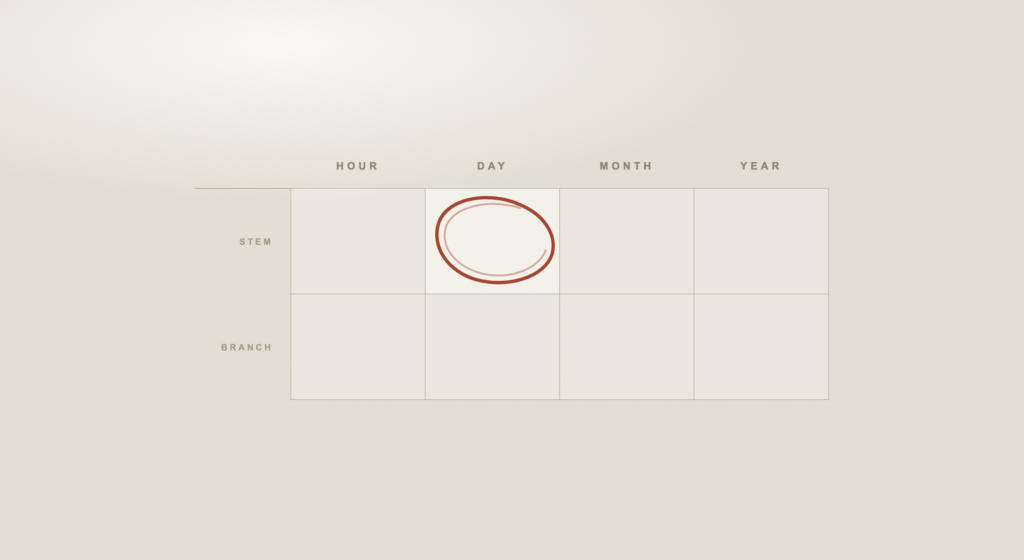
Your BaZi chart is built from four pillars, each one mapped to a specific dimension of your life’s energetic structure.
Every BaZi reading starts from three non-negotiable inputs: your exact date of birth, and your precise time of birth. Without all three, the chart cannot be accurately constructed. Date of birth gives you the Year, Month, and Day Pillars. Time of birth constructs the Hour Pillar.
Birth time is the most commonly underestimated input among first-time clients. Even a difference as small as 10 to 30 minutes can shift the Hour Pillar entirely, which changes how the chart reads. If you are unsure of your exact time, gather whatever family records or hospital documentation you can before your session. A skilled practitioner has methods to narrow the time down through a process called chart rectification, but any supporting evidence you bring shortens that process considerably.
Each pillar in your BaZi chart corresponds to a specific piece of your birth data; accuracy here is everything.
Arrive with a shortlist of three to five focused questions around your most pressing current situation. Career direction, business timing, relationship patterns, and financial decisions are the most productive areas. Open-ended questions like “What should I do with my life?” do not serve you well in a consultation. Specific, contextual questions do. For example: “My career is at a crossroads between staying in corporate or starting a business, what does my chart indicate?” gives the practitioner enough context to deliver targeted analysis rather than a generic overview.
Before you book, you can preview your own chart structure using the BaZi Explorer at destinyx.joeyyap.com, a tool developed by Joey Yap. Enter your birth data, generate your chart, and get a visual of your Day Master and elemental balance. Arriving at your first session with a basic orientation to your chart means the practitioner spends more time on applied strategy and less time on introductory explanation.
The practitioner plots your natal chart before the dialogue begins. They identify your Day Master, the element that represents the self, and map out the visible and hidden elements across all four pillars. This phase happens before you say a single word about your life. It is about establishing the structural foundation from raw data, not making interpretations yet.
The quality of this calculation phase is what separates a rigorous Four Pillars reading from a superficial one. A practitioner who skips the Real Solar Time conversion, or who does not check for hidden stems in the Earthly Branches, is working from an incomplete chart. The integrity of everything that follows depends on this step.
The Day Master sits at the centre of your BaZi chart; it is the element that represents you, and it anchors the entire analysis.
The practitioner assesses your Day Master’s strength by examining the birth season, which is represented by the Month Branch, and checking for elemental support across the rest of the chart. This determines your Favourable Element, the element your chart needs more of to restore balance. Think of this less like a spiritual reading and more like a financial health assessment: systematic, structured, and grounded in specific data points.
The practitioner then layers in your current Luck Pillar, a 10-year cycle, alongside your Annual Luck to see what energies are active right now. Only pillars that interact with the Annual Luck through combinations, clashes, or conflicts are considered activated for that calendar year. This is the phase that surfaces your chart’s structural tendencies: natural strengths, likely blind spots, and the timing windows that matter most for decisions you are currently facing.
The reading then becomes a conversation. The practitioner presents observations and asks you to confirm or contextualise them against your lived experience. This is where your prepared questions become critical. The practitioner cross-references the chart’s structural signals with your stated goals and current circumstances, refining the interpretation as the dialogue progresses.
This two-way exchange is what transforms a raw chart analysis into a personalised strategy. The practitioner is not delivering a one-way forecast from a position of authority; they are applying the chart’s signals to your specific situation with your active input. The more context you bring, the more precise the output.
There are three delivery formats to consider. An email report is a written PDF analysis, typically ranging from 6 to 35 pages depending on the package, delivered within one to two weeks of submitting your birth data and questions. A face-to-face session is a live appointment, typically 30 to 45 minutes (sometimes extending to 60), where the practitioner reads the chart directly with you present. Some practitioners also offer online video consultations as an optional format, providing live interactivity without requiring an in-person visit. For a breakdown of available formats, see the types of consultation and what each includes.
Each consultation format serves a different need, choose based on how you process information and how quickly you need answers.
The email format suits clients who want time to absorb and re-read the analysis at their own pace. Live sessions suit those who prefer real-time dialogue and the ability to ask immediate follow-up questions as the reading unfolds. Neither format is inherently superior; the right choice depends on how you process information and what your schedule allows.
A well-constructed written report functions as a strategic document, not a horoscope. A comprehensive BaZi consultation deliverable of this kind typically covers five core areas:
Clients often return to the report months or even years later as their circumstances evolve and different sections of the analysis become immediately relevant.
Some providers offer a structured follow-up mechanism after the initial delivery. One approach is an optional Q&A period allowing clients to seek clarification on specific points, for example, Joey Yap’s consultation packages and pricing include add-on Q&A options that let you submit follow-up questions without rebooking a full session. Ask about this before you book. Knowing what ongoing access you have after the initial delivery allows you to plan how you will use the analysis.
The practitioner’s role is to find solutions within your chart structure, and that requires knowing your actual situation. A well-framed question gives the practitioner the context to apply the chart accurately; strip that context away, and the analysis becomes generic. Concrete, specific questions are the single most controllable variable in how much value you extract from the session.
These five question categories consistently produce the most actionable outputs:
The quality of your question directly determines the quality of the insight you receive, reframing from vague to specific changes everything.
Several question types reliably waste consultation time. Technical or educational questions about BaZi theory, such as “What is my Useful God?” or “What does the clash in my Spouse Palace mean?”, are better suited for workshops and courses. Hypothetical “what if” scenarios with no grounding in your real life produce analysis that has nothing to act upon. Simple yes/no prediction requests close down the diagnostic process before it can produce anything useful.
Save the technical questions for structured learning environments. The consultation window is finite and its value comes from applied strategy, not theory.
Concrete outputs from a well-structured BaZi consultation include your written report or recorded session, your Favourable Element prescription, your Luck Pillar timeline with annotated turning points, and elemental or environmental recommendations covering specific directions or settings that support your chart. Frame these not as mystical prescriptions but as calibrated inputs. A nutritionist recommends dietary adjustments based on bloodwork rather than guesswork; the Favourable Element prescription works on the same principle.
The Luck Pillar timeline tells you when your chart supports expansion versus consolidation. This is directly actionable for career moves, business launches, or major purchases. The Favourable Element guidance shapes decisions about your environment and daily routine. The strategic roadmap your practitioner provides is most valuable when you treat it as a reference tool for crossroads decisions, not a fixed script for life.
Your Luck Pillar timeline maps out the energetic seasons of your life, knowing which phase you are in changes how you approach every major decision.
Clients who extract the most long-term value from a BaZi reading treat it as an ongoing strategic relationship rather than a one-time transaction. Returning for annual consultations as your Luck Pillar transitions, and using the Annual Luck analysis each year to refine your timing decisions, keeps the guidance current. Your natal chart analysis provides the stable foundation; the annual reading provides the year-specific lens that sits on top of it.
If you want to deepen your practical application, consider attending events that focus on timing and environment, for example, Events: Timing + Environment = Results, where the teaching is aimed at turning BaZi insights into operational steps.
At Joey Yap, the consultation experience is deliberately designed to feel less like a fortune-telling session and more like a structured strategy review. The practitioner arrives with a fully calculated chart, a diagnostic framework, and a clear focus on actionable output. The language is precise, the analysis is repeatable, and recommendations are grounded in the chart’s actual structure rather than intuition or vague impressions.
For clients who are analytical by nature or sceptical of anything that resembles mysticism, this distinction matters. The same rigour that separates a proper financial analysis from a speculative guess applies here. Two practitioners working from the same birth data and the same methodology should arrive at substantially consistent conclusions. That is the standard the system is built on.
The BaZi Explorer at destinyx.joeyyap.com lets you generate your chart and identify your Daymaster before your first consultation, arrive oriented, not blind.
The BaZi Explorer at destinyx.joeyyap.com is a practical first step before any formal consultation. Enter your birth data, generate your chart, and get an initial visual of your Daymaster and elemental balance. Knowing your Daymaster element going in makes the practitioner’s explanation easier to follow and allows more of the session to be spent on applied strategy rather than basic orientation.
A rigorous practitioner is distinguishable from a superficial one by a few clear markers. They ask for your exact birth time and place of birth, not just the date. The consultation produces a structured output, a written report or a strategic roadmap, rather than merely a verbal exchange you have no record of. And there is a follow-up mechanism in place so you can seek clarification after the initial delivery. The quality of any BaZi reading is directly tied to the rigour of the methodology behind it.
A BaZi consultation is a three-part process: submit accurate birth data, move through a structured diagnostic and dialogue, and receive a personalised strategic roadmap covering timing, career, relationships, and major decisions. The value is not in the reading itself, it is in how you apply the output to the decisions you are actually facing.
The clearest first step is to explore your own chart before booking anything. Visit destinyx.joeyyap.com, generate your BaZi chart, and identify your Daymaster element. Spend ten minutes familiarising yourself with the basic structure. Then write down the three to five questions that matter most to you right now. If you still have procedural questions before booking, check the consultation FAQ.
A successful BaZi consultation process depends on accurate birth data, focused questions, and a methodology grounded in proper calculation. Arrive at your first consultation oriented, prepared, and ready to engage. That shift alone determines whether you leave with a piece of paper or a genuine strategic tool.
Get Joey Yap’s latest insights and updates straight to your inbox.

Animal Signs, Article
The 12 Animal Signs are the familiar Chinese zodiac animals. Learn their order, what they represent and why your birth-year
Article, Feng Shui
Flying Star Feng Shui calculates a chart for a building from its direction and period. Here is what Period 9

Article, BaZi, Channelling Kongming
A Rob Wealth year is usually read as a threat to defend against. Read more carefully, the warning inside it
Article, BaZi
Your Day Master is the one character in a BaZi chart that represents you, out of ten possible types. Here